Trans Bhutan Trail — Our Intrepid Itinerary and What to Expect at Each Stop
This article was written ahead of our November 2026 trip. We’ll update it with first-hand experience when we return in December.
This article contains affiliate links. If you book or purchase through these links I may earn a small commission at no extra cost to you. I only recommend products and companies I genuinely use or have researched thoroughly.
We arrive in Bhutan on 13 November 2026 — three days after the Evertrek EBC trek ends in Kathmandu. Eighteen days at altitude in Nepal, three nights recovering in Kathmandu, then a 90-minute Druk Air flight west into Paro.
The Trans Bhutan Trail is a historic route that once connected the country’s valleys, dzongs, and monasteries before the road network arrived. It retraces a 60-year-old route through Bhutan’s remote villages and breathtaking landscapes once used by Bhutanese people to trade salt from east to west. Today it’s a multi-stage trekking route running roughly 400km from west to east across the country — or in our case, a curated 10-day section with Intrepid Travel that covers the western and central highlights.
We’re doing this immediately after EBC. Our legs will have opinions. Here’s the itinerary and what we know before we arrive.
Why the Trans Bhutan Trail After EBC?
The honest question — are we mad to attempt a second major trek three days after finishing EBC?
Possibly. But the Trans Bhutan Trail operates at 1,200–3,100m — dramatically lower than anything we’ve experienced in Nepal. After 18 days at 4,000–5,400m, hiking at 1,500m will feel like walking on flat ground. The altitude acclimatisation works in our favour rather than against us.
The character of the trekking is also completely different. EBC is a physical test. The Trans Bhutan Trail is a cultural immersion — hiking through living villages, past working monasteries, into dzong courtyards that haven’t changed for centuries. You hike through rather than across Bhutan.
The itinerary is also structured with vehicle support on most days — you hike a section of the trail, then meet transport to the next location. It’s not continuous camping trekking, it’s walking with purpose through a country that doesn’t let you speed through it.
The Trail — Background and Context
The Trans Bhutan Trail connects the country’s key cultural and natural sites along an ancient route through the Himalayan foothills. Sections of the trail pass through farmland, forest, and alpine terrain at altitudes ranging from around 1,200m in the Punakha valley to over 3,100m at the higher passes.
Bhutan’s strict tourism model means the trail is never crowded — the Sustainable Development Fee (USD $100 per person per night) filters visitor numbers by design. The result is a trail that feels genuinely remote even in its most visited sections. Full details on the SDF in the Bhutan Sustainable Development Fee guide.
Our Itinerary — Stop by Stop
Day 1–2 — Paro Arrival and Thimphu
Paro sits at 2,200m at the end of one of the world’s most dramatic airport approaches — the Druk Air pilots who fly into Paro’s mountain-ringed runway are among a small group of specially certified aviators. The approach itself is worth the trip.
From Paro we transfer to Thimphu — Bhutan’s capital and largest city, with a population of around 120,000. Thimphu is compact, walkable, and genuinely charming in a way that larger Asian capitals rarely are. The Intrepid itinerary begins with an orientation walk around Thimphu’s highlights and a welcome dinner featuring red rice and chili cheese — Bhutan’s signature dish.
The Buddha Dordenma statue — a 51-metre gilded Buddha overlooking the city from a hilltop — is the visual anchor. The view from the base covers the entire Thimphu Valley and on a clear morning reaches the peaks of the main Himalayan range to the north.
Day 3 — Lobesa
From Thimphu the trail drops south and west into the Punakha Valley via the Dochula Pass at 3,116m — 108 memorial chortens on the pass summit that appear suddenly from the mist. On a clear day the views of the main Himalayan range, including Gangkhar Puensum (the world’s highest unclimbed peak), are extraordinary.
The trail descends from Dochula Pass to the valley and follows the Divine Madman Trail — named for an eccentric 15th century monk — through the village of Lobesa. Chhimi Lhakhang, the Fertility Temple, sits above the village on a small hill reached by a short walk through paddy fields. The temple is dedicated to Drukpa Kunley, one of Bhutan’s most beloved and unconventional Buddhist saints. The walk through the fields is one of the more peaceful sections of the entire trail.
Day 4–5 — Punakha
Punakha sits at 1,200m — the lowest point on our itinerary and the warmest. The Punakha Dzong, built at the confluence of two rivers in 1637, is arguably the most beautiful building in Bhutan. It served as the country’s capital and administrative centre for centuries and still functions as the winter residence of Bhutan’s central monk body.
The trail around Punakha Valley includes the Khamsum Yuelley Namgyal Stupa — a 45-minute hike through paddy fields to a hilltop offering panoramic valley views — and visits to the villages of Talo and Nobgang on the ridge above.
Punakha is also home to the Sangchen Dorji Lhendrup Nunnery, a temple perched on a ridge with spectacular views of the Punakha and Wangdue valleys, housing one of the largest bronze Buddha statues in the country.
Day 6 — Trongsa
The drive from Punakha to Trongsa covers 150km through the heart of Bhutan — the road climbing to high passes and dropping into valleys. Trongsa sits at around 2,200m at the geographical centre of the country, historically the most strategic location in Bhutan.
Trongsa Dzong is Bhutan’s largest and most magnificent dzong, perched dramatically on a cliff overlooking the Mangde Chu river gorge. Every king of Bhutan has governed from Trongsa before ascending the throne — it’s not a decorative heritage site, it’s the place where Bhutanese political history happened. The Ta Dzong museum above the main fortress puts that history in context.
Day 7–8 — Bumthang
Bumthang is the spiritual heartland of Bhutan — a high valley at around 2,800m containing some of the oldest temples in the country. Trekking through the Bumthang valleys takes you past crystal clear rivers, pristine rhododendron forests, and along mountain ridges, with the option to stay in a homestay to soak in local life.
The Jambay Lhakhang temple dates to the 7th century and is one of 108 temples reportedly built in a single day across Tibet and Bhutan to pin down a demoness. The Kurjey Lhakhang complex contains the body print of Guru Rinpoche — the Indian master credited with bringing Buddhism to Bhutan — pressed into the rock.
Bumthang also hosts the Bumthang Brewery, producing Red Panda Beer and operating Bhutan’s only commercial cheese factory — both legacies of a Swiss development project. After two weeks in Nepal and several more days trekking, the case for a Red Panda Beer at the source is strong.
Day 9 — Punakha
The itinerary returns to Punakha — a second look at the dzong and valley from a different direction, with more time to explore the riverside paths and suspension bridges across the Mo Chu and Pho Chu rivers. Punakha feels different the second time: more familiar, less overwhelming, more open to sitting still and watching it.
Day 10–11 — Paro and Tiger’s Nest
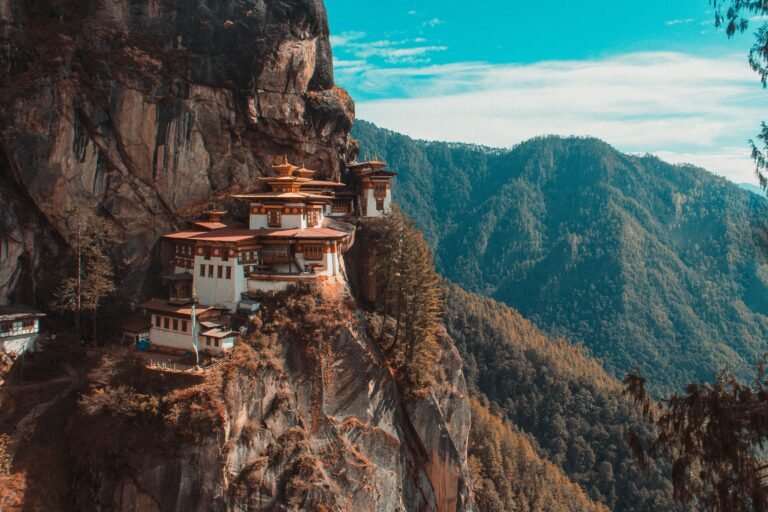
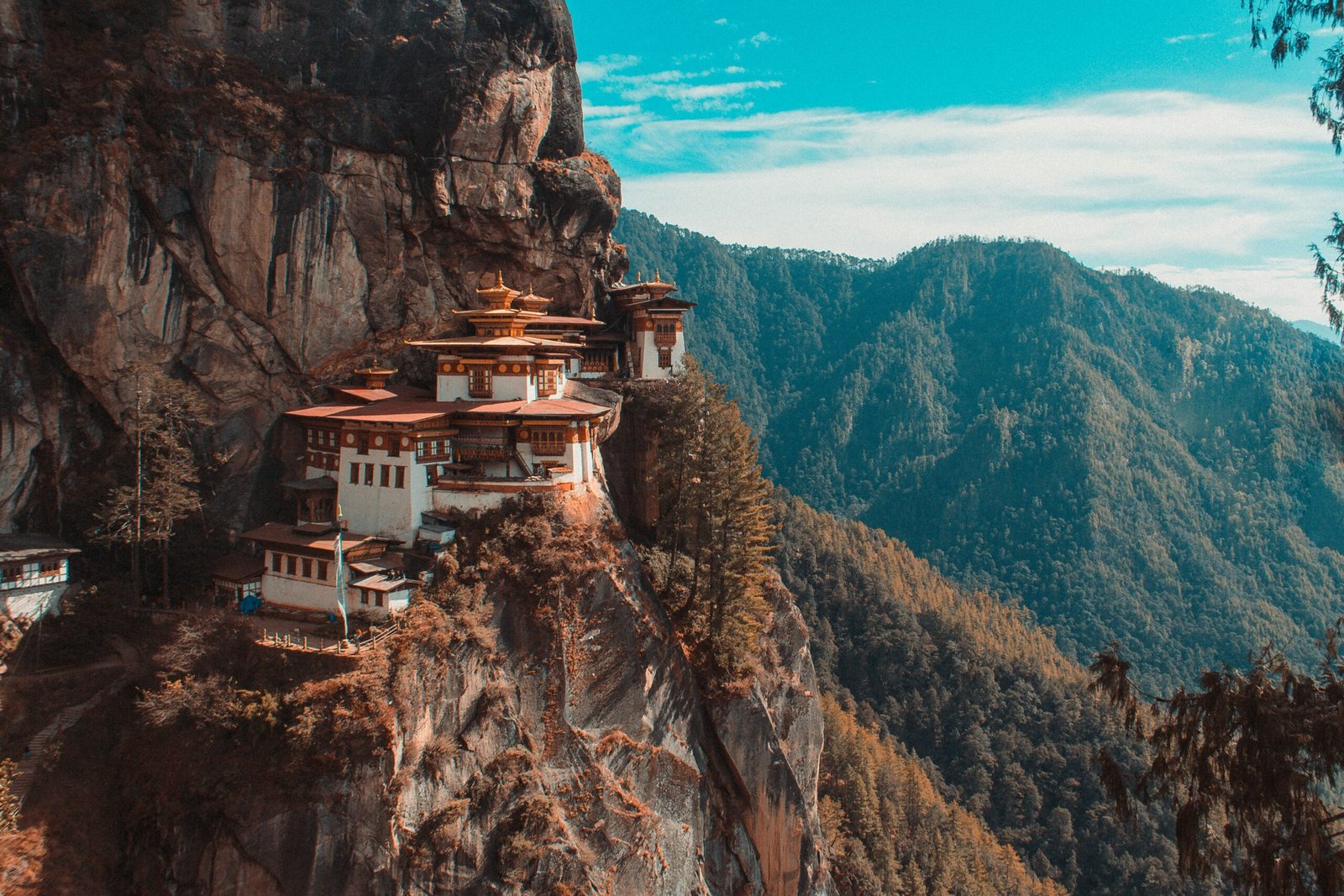
Paro is saved for last — specifically for Taktsang, the Tiger’s Nest Monastery. The iconic monastery clings to a cliff face 900m above the Paro Valley, accessible by a 2–3 hour hike from the valley floor. It is the most photographed and most visited site in Bhutan — and for good reason.
The hike is well-constructed with regular rest points and a halfway teahouse. The monastery itself is reached by a final descent and ascent across a waterfall ravine. Entry requires removing shoes and following specific protocols — your guide manages all of this.
For us, Tiger’s Nest comes at the end of nearly five weeks of continuous trekking across Nepal and Bhutan. There may be a certain amount of arriving on fumes. There will also be a certain amount of genuine emotional response to finishing in this particular place.
Physical Demands — Honest Assessment
The Trans Bhutan Trail as Intrepid operates it is not a continuous endurance trek. Most days involve 3–6 hours of walking with vehicle support between stages. The terrain is well-maintained trail through farmland, forest, and valley paths — significantly less demanding than EBC in physical terms.
The altitude range of 1,200–3,100m is manageable, particularly coming down from 5,000m+ in Nepal. The main challenge is accumulated fatigue — after EBC, our bodies will be tired in ways that even rest days in Kathmandu won’t fully resolve. The itinerary’s gentler pace is appropriate.
What We’re Looking Forward to Most
Honestly — the cultural depth. EBC is spectacular and physical and transformative. Bhutan promises something different: a country that exists almost entirely on its own terms, that has resisted the pressures that have homogenised so much of Asia’s tourist trail, and that uses hiking as a vehicle for cultural immersion rather than as an end in itself.
Tiger’s Nest is the postcard. But the paddy fields in Lobesa, the dzong at Trongsa at sunrise, and whatever we find in Bumthang over two nights — these are the things we’ll probably remember most.
We’ll update this article honestly in December with how it actually felt compared to how we imagined it.
More From Above the Cloud Treks
- Bhutan Sustainable Development Fee — What It Covers
- Combining Bhutan and EBC in One Trip
- EBC Trek Guide for Non-Mountaineers
- Altitude Sickness on the EBC Trek
Andrew Dillon is a data consultant, runner, and triathlete based in Auckland, New Zealand. He is completing the Trans Bhutan Trail with Intrepid Travel in November 2026, following the EBC via Gokyo trek with Evertrek in October 2026. Follow his journey at abovethecloudtreks.com.