Tech for the EBC Trek — The Kit We’re Taking to 5,364 Metres
This article contains affiliate links. If you book or purchase through these links I may earn a small commission at no extra cost to you. I only recommend products and companies I genuinely use or have researched thoroughly.
Most EBC packing guides focus on clothing and footwear. Tech tends to get a paragraph at the end — “bring a head torch and a power bank” — and that’s it.
Given we’re spending 18 days at altitude in some of the most dramatic landscapes on the planet, and given that I’ve thought carefully about every piece of technology we’re taking, it deserves more than a paragraph. This is the full rundown of our tech for the EBC trek — what we’re bringing, why we chose it, and what we decided to leave behind.
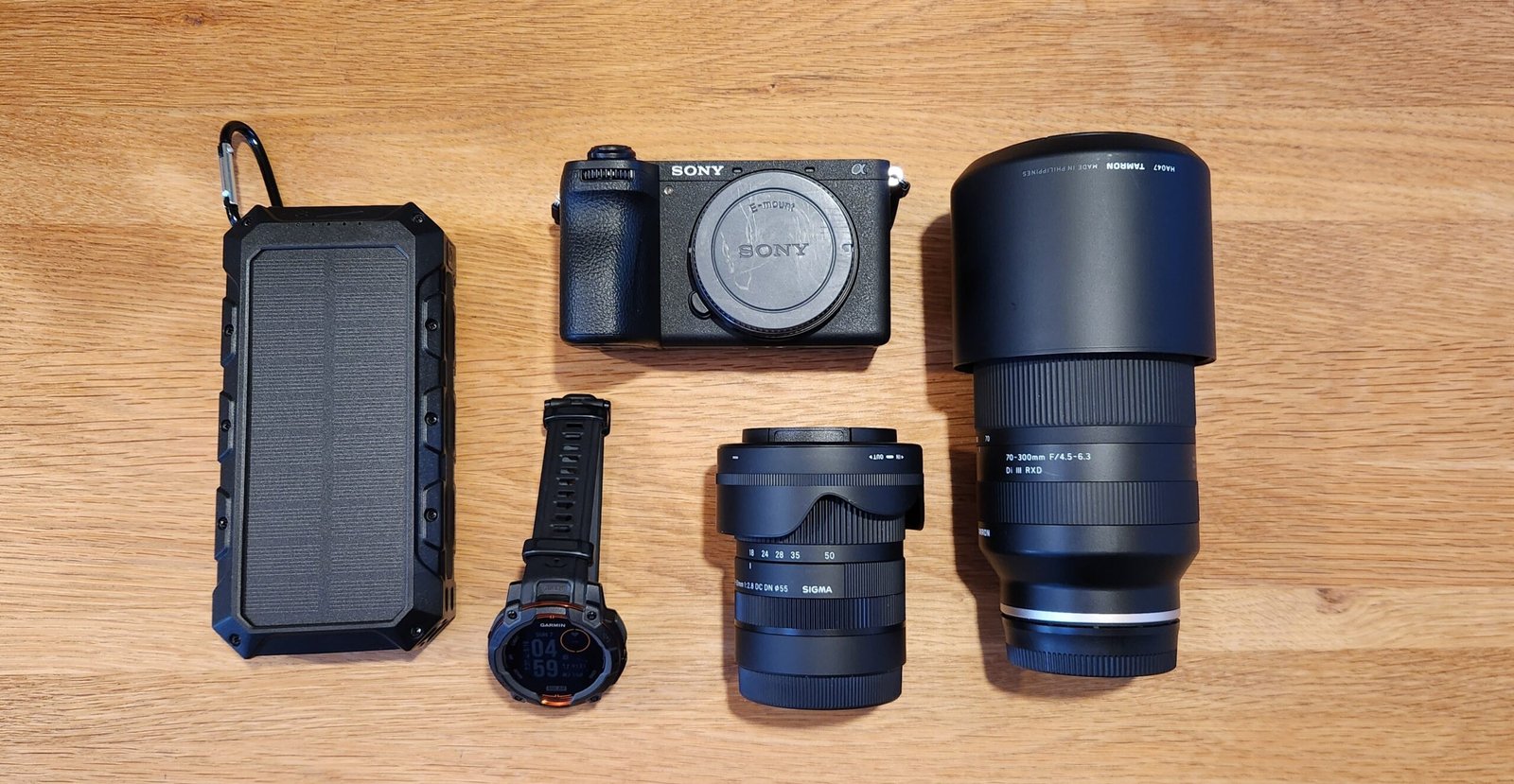
GPS Watch — Garmin Instinct 3 Solar
My previous watch was a Garmin Forerunner 935 — bought when Elaine and I started getting more serious about triathlon training. It served eight years of daily use and genuine abuse before finally giving up in January 2026. Eight years. That alone tells you something about Garmin build quality.
When it came time to replace it, I looked at the current Forerunner lineup and struggled to justify the price of the latest models. The newer Forerunners are excellent watches, but they’re packed with features I’d never use — music storage, contactless payments, animated workout instructions. I wanted something that did the fundamentals exceptionally well without the premium price tag of features I don’t need.
That’s when I found the Instinct 3 Solar, and it was an easy decision once I understood what it actually offered.
Battery life is the headline. In smartwatch mode with sufficient sunlight, the battery life is effectively unlimited. In GPS mode it reaches up to 40 hours — significantly more than comparable Forerunner models. In practice across daily use including recording activities, I’ve been getting well over two weeks between charges. For an 18-day EBC trek where charging opportunities are limited and expensive in teahouses, this matters enormously.
The solar version extends this further. Garmin’s solar layer delivers up to 130 hours of GPS battery life — and in smartwatch or expedition mode, solar charging maintains an effectively unlimited battery. Long days outside in the Himalayas in October means significant solar exposure. I’m hoping to record every day of the trek, which would be impossible with most smartwatches.
One grumble worth sharing honestly: there’s nothing on the watch face or in the app that tells you how much of your charge came from solar vs the battery. A small thing, but I’d like to know.
The sensors are comprehensive. Heart rate, altimeter, barometer, compass, and crucially a pulse oximeter — relevant at altitude for monitoring blood oxygen saturation as discussed in the altitude sickness article. The GPS offers four reception options: GPS only, All Satellites, Multi-Band, and UltraTrac — with Multi-Band offering the best accuracy at the cost of battery life. For EBC I’ll run GPS-only to preserve battery on long days.
The built-in torch is unexpectedly useful. It has a red light option which proved genuinely valuable in the Kepler Track huts — you can check your gear, find the bathroom, or navigate the dorm without waking everyone around you. A small feature that earns its place.
The aesthetics. Not everyone’s taste — it’s a chunky, utilitarian watch that looks more tactical than stylish. I genuinely don’t care about that. It does everything I need it to do and then some.
Camera — Sony A6700 with Sigma 18-50mm and Tamron 70-300mm
Between Canada, Nepal, and Bhutan, 2026 is a significant photography year for us. We wanted to capture it properly.
We had some DSLR experience before moving to New Zealand in 2013 — but gradually surrendered to the convenience of phone cameras over the following years. Good phone cameras made it easy to justify not carrying a separate body. But phone cameras have limits, and those limits are most visible at distance, in low light, and when you want creative control over depth of field. In the Himalayas, all three matter.
The decision to go back to a dedicated camera for this trip was straightforward. Choosing which one took more thought.
Why mirrorless over DSLR: Weight and size. The Sony A6700 measures 4.87 x 2.75 x 3.0 inches and weighs around 493g with battery and memory card. A comparable DSLR setup would be significantly heavier — and when you’re already managing a daypack weight limit for Lukla flights, every gram counts.
Why the A6700 specifically: The Sony A6700 combines a 26MP APS-C sensor with AI-powered subject recognition autofocus in a body built for shooting on the move — a compelling hybrid for those who value power and portability in equal measure. It’s been around a few years now, which means the price has come down while the performance remains excellent. We’re not professional photographers — we don’t need the latest model. We need something that produces outstanding images reliably in varied conditions and doesn’t require a dedicated camera bag to carry.
The camera also features dust and moisture resistant sealing — relevant when you’re trekking above 5,000 metres where conditions can change fast and the weather won’t always cooperate.
The lenses — Sigma 18-50mm and Tamron 70-300mm:
Lens choices are where camera costs can spiral out of control very quickly. Sony’s own E-mount lenses are excellent and priced accordingly. We chose third-party options that give us the range we need at a more sensible price point.
The Sigma 18-50mm covers wide-to-standard — ideal for landscape shots, teahouse interiors, and general travel photography. The Tamron 70-300mm gives us reach for distant peaks, wildlife if we encounter it, and the kind of compressed-perspective mountain shots that make Himalayan photography so compelling. Together they cover almost every situation we’re likely to encounter.
Phones — Samsung Galaxy S22+
We’ve had these for a few years and they’re still performing well. Photo and video quality is excellent — the camera system handles low light better than most people expect from a phone of this age, and battery life is holding up.
The honest truth is we’d love to upgrade to a newer model. But when a phone is still doing everything the latest models can do, it’s hard to justify the cost — especially in a year where we’ve already spent significantly on camera gear, sleeping bags, and trek fees.
On the trek, the phones serve primarily as navigation backup (Gaia GPS or Maps.me downloaded offline), communication via teahouse WiFi, and a second camera for casual shots. The A6700 is the primary camera; the S22+ is the backup and daily convenience device.
Head Torch — Petzl Tikka+
We bought these for our first multi-day hike — the Three Capes Track in Tasmania in December 2017. That’s nine years of use across multiple countries, multiple treks, and whatever else life throws at a head torch.
The fact that I’m writing about it as our EBC choice rather than a replacement speaks for itself. Petzl quality is real.
On the EBC trek, a head torch is non-negotiable — pre-dawn starts are common, teahouses have unreliable lighting, and the Ramechhap transfer means being in a vehicle before 2am. Bring spare batteries regardless of torch brand. At altitude, cold drains batteries significantly faster than at sea level.
The Garmin Instinct 3’s built-in torch handles the middle-of-the-night dorm navigation — but for proper trail use and any technical sections, the Tikka+ is what goes on our heads.
Power Bank — Solar 30,000mAh
Charging in teahouses costs money — typically USD $2–5 per charge — and isn’t always available above Namche Bazaar. A high-capacity power bank is the practical solution.
We’re taking a 30,000mAh power bank with a solar panel. It’ll charge the phones multiple times and top up the camera battery. The watch largely takes care of itself via solar. At 450g it’s not featherweight, but the charging independence on an 18-day trek is worth it.
Memory Cards
Bring more than you think you need and store them in two separate places. At 26 megapixels per shot and 4K video, the A6700 generates large files quickly. We’re taking two 256GB cards — one primary, one backup kept in the daypack rather than the camera bag.
A USB card reader for reviewing shots on the phone each evening is worth adding — it means you can back up to the phone without needing a laptop.
What We’re Leaving Behind
Laptop — we considered it for editing on the trip. Left it out. The EBC trek is not a working trip and the weight isn’t justified for 18 days.
Drone — Nepal has strict drone regulations in the national park areas and near military installations. Don’t bring one unless you’ve researched current permissions thoroughly — the rules change and enforcement is real.
Action Camera — we considered one for action footage on the Cho La Pass crossing. Decided the Sony handles video well enough and we’d rather have one less thing to manage.
The Honest Summary on Tech for the EBC Trek
The tech we’re taking is chosen for function over features. The Garmin Instinct 3 Solar is the watch I’d recommend to anyone doing a long multi-day trek — the battery life alone justifies it. The Sony A6700 is a serious camera in a manageable package. The Petzl Tikka+ has earned its place after nine years. Everything else is supporting cast.
One piece of general advice: test everything before you go. The EBC trail is not where you want to discover your power bank doesn’t charge your camera model, or that your watch’s GPS struggles in valley terrain. We’ll be road-testing all of this in the Run21 10K’s and in the altitude training sessions over the coming months.
Gear Mentioned in This Article
- Garmin Instinct 3 Solar — View on Amazon
- Sony A6700 — View on Amazon
- Sigma 18-50mm E-mount lens — View on Amazon
- Tamron 70-300mm E-mount lens — View on Amazon
- Petzl Tikka+ head torch — View on Amazon
- Solar 30,000mAh power bank — View on Amazon
More EBC Planning Guides
- The Honest EBC Packing List
- Everest Base Camp Cost – A Complete and Honest Budget
- Sleeping Bag for EBC — Hire vs Buy
- Altitude Sickness on the EBC Trek
- How to Train for Everest Base Camp
- EBC Trek Guide for Non-Mountaineers
Andrew Dillon is a data consultant, runner, and triathlete based in Auckland, New Zealand. He is trekking EBC via Gokyo with Evertrek in October 2026. Follow his journey at abovethecloudtreks.com.