How to Train for Everest Base Camp — A Triathlete’s Honest Guide (2026)
This article contains affiliate links. If you book or purchase through these links I may earn a small commission at no extra cost to you. I only recommend products and companies I genuinely use or have researched thoroughly.
Most EBC training guides focus on the minimum. What’s the least fit you can be and still make it to Base Camp? What’s the slowest you can walk and still reach Gorak Shep before dark?
That’s not the question I’m asking.
I want to arrive at Everest Base Camp having genuinely enjoyed every single day of the trek. I want energy in the tank at the end of each stage. I want to look at the mountains rather than stare at my boots. I want the altitude to be the challenge — not my legs.
That requires a different approach to training. This is my own ‘how to train for Everest Base Camp’ guide.
The Backstory — From 100kg to Base Camp
When my wife and I moved from Scotland to New Zealand in 2013, I was in the worst shape of my adult life. Nearly 100kg at 183cm, I could barely run a kilometre without stopping. The mountains I’d spent years hiking in Scotland felt like a distant memory.
What changed everything was finding an active community in Auckland and a personal trainer who became a genuine friend. Gayle Clark of Bodywise has guided my fitness journey since those early NZ days — training plans for running, triathlon, bootcamp sessions, the works. The transformation that followed was the kind that changes your relationship with fitness permanently.
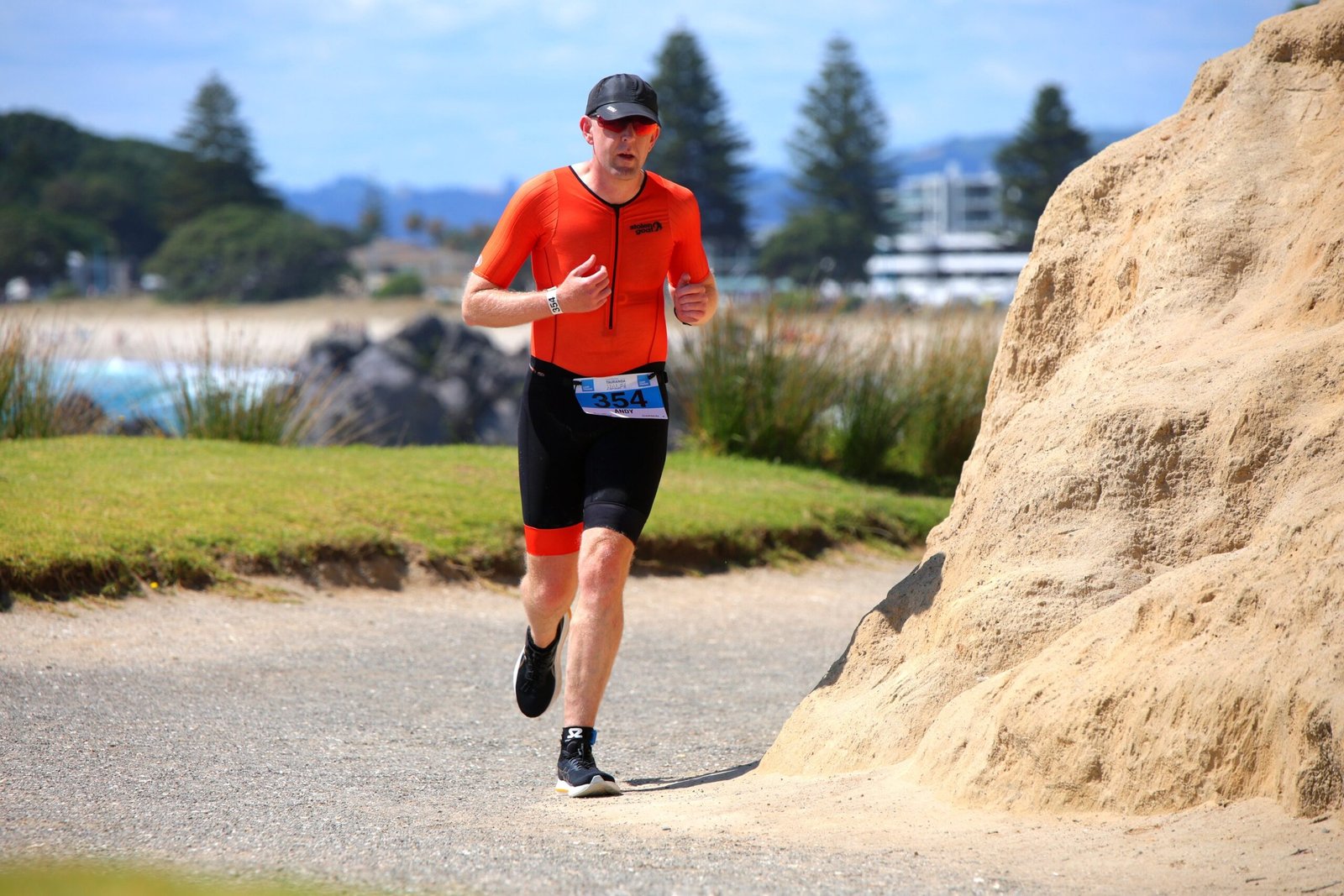
By January 2025 I completed the Mount Festival of Multisport Half Iron Distance Triathlon — 1.9km swim, 90km bike, 21.1km run — in 5 hours 46 minutes. At 83kg, not my lightest but certainly my fittest and strongest.
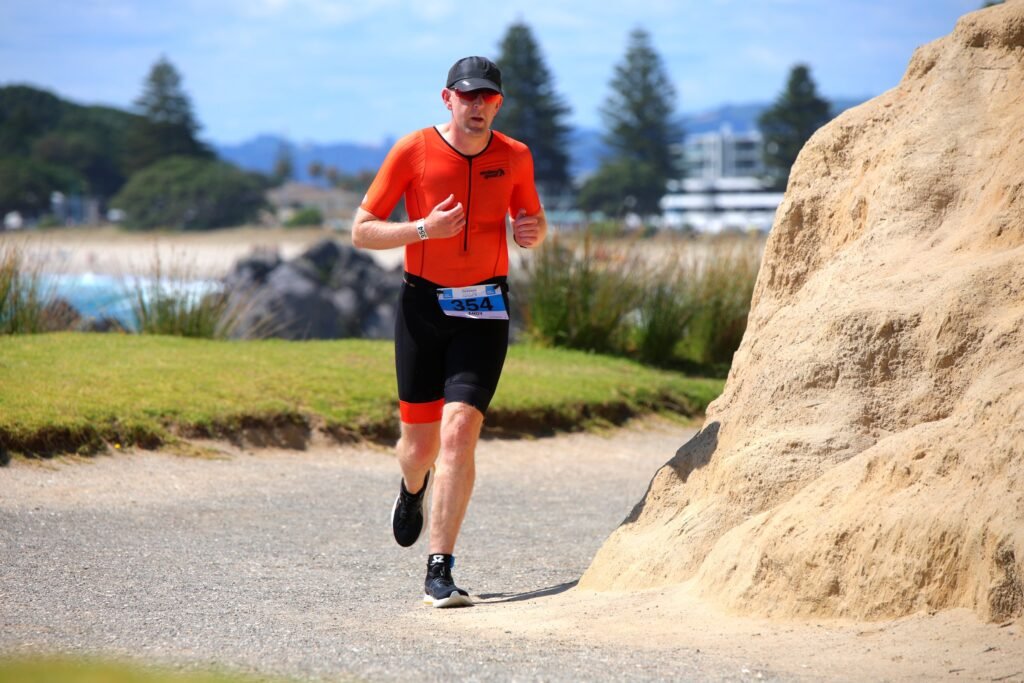
Now at 85kg, with EBC booked for October 2026, I’m asking my body to do something entirely different. Not race pace. Not power output. But sustained endurance over 18 consecutive days at altitude — some of it above 5,000m where oxygen levels are roughly half what they are at sea level.
The triathlon background helps enormously. But it doesn’t solve everything.
Why Fitness Alone Isn’t Enough for EBC
Let me be direct about something most training guides gloss over: you can be extraordinarily fit and still struggle at altitude.
Altitude sickness doesn’t discriminate by fitness level. Elite athletes get it. Sedentary people sometimes sail through. Your VO2 max, your marathon PB, your Strava segments — none of them guarantee an easy passage through the Khumbu above 4,000m.
What fitness does is give you the best possible foundation. A strong cardiovascular base means your heart and lungs are working efficiently before altitude adds its handicap. Strong legs mean the 8-hour days don’t destroy you. Mental resilience built through hard training sessions means you know how to push through discomfort.
But altitude acclimatisation requires time — time built into your itinerary, not something you can train away. The acclimatisation days at Namche Bazaar (3,440m) and Gokyo (4,790m) in the Evertrek itinerary are non-negotiable regardless of how fit you arrive.
The goal of training isn’t to beat altitude. It’s to arrive strong enough that altitude is the only challenge.
My Current Training Week
I train almost every day. This isn’t obsessive — it’s become a natural part of life since joining a genuinely active community in Auckland. Here’s a typical week right now, five months out from the trek:
Monday
- Morning: 30-45 minute recovery cycle — easy pace, just moving the legs
- Evening: 60 minute Bodywise bootcamp with Gayle at 6pm — glutes focused
Tuesday
- Morning: 60 minute Bodywise run group at 6am — speed focused
- This week: 8 x 500m at 3km race pace with recovery intervals
Wednesday
- Morning: 45-60 minute cycle
- Evening: Upper body strength session
Thursday
- Morning: Easy 5km run
- Evening: Leg strength session
Friday
- Rest day — genuinely important for recovery and adaptation
Saturday / Sunday
- Long run (currently up to 12km)
- Long bike (currently up to 60km)
- Total body strength session across the weekend
Total weekly volume: 6 days of activity, mix of cardio, strength, and speed work.
What’s Already Working for EBC
Looking at this training week through an EBC lens, several elements are already well aligned:
Cardiovascular volume Six days of aerobic activity builds the aerobic base that matters most at altitude. Your heart and lungs adapt to sustained effort — exactly what 8 hours of daily trekking requires.
Speed work The Tuesday interval sessions (8 x 500m at race pace) build cardiovascular efficiency — the ability to work hard with less effort. At altitude, this efficiency becomes critical. Every beat of the heart, every breath, needs to deliver maximum oxygen.
Leg strength The Thursday leg sessions are gold for EBC specifically. Strong quads and glutes protect your knees on steep descents — and the Gokyo route has some brutal ones, particularly the Cho La Pass descent. Trekkers who neglect strength training often find the descents harder than the ascents.
Back to back days Training six days a week with only one rest day builds exactly the kind of fatigue resistance needed for 18 consecutive trekking days. Your body learns to perform without full recovery — which is the EBC reality.
Mental resilience This might be the most underrated training benefit. Anyone who has pushed through the back half of a half iron distance triathlon or a speed session at 6am in a NZ winter knows how to operate when it’s uncomfortable. That mental toolkit transfers directly to altitude.
How Training Needs to Evolve — Month by Month
Five months is enough time to build significantly. Here’s how the training needs to shift between now and October:
June — Build and Race
- Run21 Ōrewa 10km (14 June) — first race of the series. Keeps training honest and provides a fitness benchmark
- Begin sessions at the Auckland Altitude Training Centre — simulated altitude exposure starts building physiological adaptation
- Extend long runs from 12km toward 15-16km
- Add weighted pack walks — start with 6kg, build to 10kg over the month
- Maintain current strength programme
July — Endurance Focus
- Run21 Onehunga 10km (12 July) — second race
- Continue altitude training sessions — increasing duration and simulated elevation
- Long runs to 18km
- Introduce back-to-back long days: long hike Saturday, long run or bike Sunday — both days with weighted pack
- Begin stair sessions with pack — find a multi-storey building or stadium steps and use them
August — Trek Specificity
- Run21 Tāmaki River 10km (2 August) — final race of the series
- Training becomes more trek-specific: longer hikes with full pack weight (8-10kg), consecutive days
- Final altitude training sessions
- Reduce cycling volume, increase hiking volume
- One or two full day hikes in the Waitākere Ranges or similar — as close to EBC day length as possible in NZ
September — Taper, Travel and the Perfect Warm-Up
This is where our preparation takes an unexpected but genuinely ideal turn.
We leave New Zealand on 11 September for five weeks of travel before Nepal — and the itinerary couldn’t be better designed for EBC preparation if we’d planned it that way.
Canada — Weeks 1-3: Whistler, Jasper, Banff Three weeks of day hiking in the Canadian Rockies. Jasper and Banff trails reach 2,000m+ elevation — meaningful altitude exposure in the weeks immediately before EBC. This isn’t casual sightseeing. It’s active, high-elevation hiking that keeps the legs working and begins the acclimatisation process naturally. A better pre-trek warm-up would be hard to design deliberately.
Canada — Weeks 4-5: Quebec, Montreal, Ottawa, Toronto Two weeks of city exploration through eastern Canada. Lower physical intensity — walking rather than hiking — which provides natural recovery while keeping the legs moving. Good timing for mental decompression before the intensity of Nepal.
Scotland — Final week One week in Scotland before flying to Kathmandu. Whether that involves walking in the hills or simply resting and preparing kit, arriving in Nepal from Scotland rather than directly from New Zealand reduces travel fatigue significantly.
The overall September arc — active Canadian Rockies hiking, recovery in eastern Canada, rest in Scotland — is almost perfectly structured as a pre-trek taper. Volume reduces progressively while activity continues. By the time we land in Kathmandu we’ll have been moving in mountains for three weeks.
The Run21 Series — Why Racing Matters for EBC Training
The three Run21 10km events — Ōrewa in June, Onehunga in July, and Tāmaki River in August — aren’t just races. They’re training anchors.
Without races on the calendar, long training blocks have a tendency to drift. It’s easy to cut a session short, skip a long run, or let the intensity drop when there’s no accountability. A race date concentrates the mind.
The 10km distance is also well chosen for this phase of training. Long enough to require proper preparation, short enough that recovery doesn’t eat into the following week’s training. Each race provides a concrete fitness snapshot — am I where I need to be?
The timing is near perfect. Three races across June, July and August gives a progressive fitness arc through the core training period, with the final race in early August leaving eight weeks to build, taper, and travel before the trek begins.
The Altitude Training Centre — Addressing the One Gap
No matter how well prepared you are at sea level, nothing fully replicates the physiological challenge of thin air at 5,000m. This is the one gap in conventional training that can’t be closed by running more kilometres or lifting heavier weights.
Simulated altitude training works by exposing your body to hypoxic conditions — lower oxygen environments — that trigger similar adaptations to real altitude. Your body responds by producing more red blood cells, improving oxygen delivery efficiency, and adapting to working with less available oxygen.
The Auckland Altitude Training Centre offers exactly this — and the fact that it’s conveniently close to where we live makes it a practical addition to the programme from June.
The centre describes altitude training as suitable not just for athletes but for mountaineers specifically, with benefits including improved cardiovascular efficiency and adaptation to lower oxygen environments.
Will altitude training eliminate the risk of altitude sickness on the trek? No — nothing does. But it gives your body a head start on the adaptation process, potentially reducing symptoms and improving performance at elevation.
I’ll write a dedicated article on our experience at the Altitude Training Centre once we’ve completed our sessions — including whether it made a noticeable difference on the trek itself.
The Kepler Track — The Benchmark Test
In April 2026 we completed the Kepler Track Great Walk in Fiordland — 60km over 4 days, approximately 2,000m of total ascent, carrying a 15kg pack, in conditions that hit -10°C wind chill on the exposed ridge sections.
No real issues. No significant fatigue. Genuine enjoyment throughout.
That result was important for two reasons. First, it confirmed the training base is solid — sustained multi-day effort with elevation and weight is achievable. Second, it provided a psychological anchor. When I’m at 4,500m wondering whether I have what it takes to reach Base Camp, I’ll remind myself of day two on the Kepler Ridge in the wind and cold. That confidence is worth as much as any fitness metric.
The Kepler isn’t a perfect EBC proxy — the altitude is incomparable, and the Gokyo route’s 18 consecutive days versus Kepler’s 4 is a significant difference. But it proved the foundation. EBC is the next step, not a leap into the unknown.
Check out our experience on the Kepler Track here.
The Bodywise Community — Why Training with Others Matters
One element of my preparation that doesn’t appear in any training plan is the community aspect. The Bodywise run group at 6am on Tuesday mornings. The bootcamp sessions with Gayle on Monday evenings. The active friends who make training a social activity rather than a solitary chore.
This matters more than people acknowledge. On the days when motivation is low, accountability to a group and a coach gets you out of bed. On the days when sessions are hard, company makes them manageable. The culture of activity that surrounds you shapes your identity as someone who trains — which makes the training sustainable over the long arc of an EBC preparation block.
If you’re preparing for EBC and training entirely alone, consider joining a running group, a bootcamp, or a hiking club. The social infrastructure around your training is as important as the programme itself.
Training for EBC — Key Principles
Whether you’re a triathlete like me or a complete beginner to endurance sport, these principles apply:
1. Start earlier than you think you need to Evertrek recommend at least 3-4 months of consistent training. I’d suggest 5-6 months for anyone without a strong existing fitness base.
2. Hike with a pack Running and cycling build cardiovascular fitness. But hiking with a 6-8kg pack builds the specific leg and hip strength that EBC demands. Get on trails with weight on your back as often as possible.
3. Do back to back days Single long efforts don’t prepare you for consecutive days. Schedule back to back long hikes, especially in the final 8 weeks before departure.
4. Train on stairs If you can’t access hills regularly, stairs with a weighted pack are the next best thing. They build the quad strength needed for sustained ascent and the eccentric strength needed to protect knees on descent.
5. Don’t neglect strength Leg strength — particularly quads, glutes and hip flexors — is the difference between enjoying descents and suffering through them. A twice-weekly strength programme throughout your training block pays dividends on every downhill section.
6. Consider altitude training If you have access to a simulated altitude facility, use it. Even a few sessions can begin the physiological adaptation process before you arrive in Nepal.
7. Train your mind Hard training sessions build mental as well as physical resilience. Push through the uncomfortable moments in training — they’re deposits in the bank you’ll draw on at 5,000m.
Evertrek’s Training Recommendations
To get ready for EBC via Gokyo, Evertrek recommend you should be able to:
- Hike for 4-6 hours per day carrying a 6-8kg daypack
- Climb 500-800m of elevation gain including steep and uneven terrain
- Handle multi-day hikes with a consistent pace and no full rest days
They recommend training 4-5 times per week for at least 3-4 months before the trek, focusing on cardiovascular fitness, leg and core strength, consecutive long hikes carrying a pack, and stair training with a weighted pack.
By October, my training will comfortably exceed all of these benchmarks. The goal isn’t to meet the minimum — it’s to arrive at Base Camp with something left in reserve.
An Honest Assessment
Am I ready right now? No — and I shouldn’t be, with five months to go.
Am I on track? Yes — genuinely.
The cardiovascular base from years of running, cycling and triathlon is solid. The Kepler Track proved the multi-day hiking capability. The strength programme protects the joints that take the most punishment. The Run21 races keep the training sharp. The Altitude Training Centre addresses the one gap no amount of sea-level training can close.
What remains is executing the plan — progressively building load, introducing trek-specific elements, tapering at the right time, and arriving in Kathmandu healthy, rested, and confident.
I’ll update this article as the training progresses — and publish a full post-trek assessment of what worked, what I’d change, and whether all of this preparation was enough to genuinely enjoy every day on the mountain.
That’s the goal. Every single day.
Update – June 2026
We caught up with Walter at the The Altitude Training Centre to discuss training for EBC and understand more about the options available to us. The challenge for us is that we have a 6-week gap between leaving Auckland and arriving in Kathmandu. We have decided on two 5-week cycles of 2 sessions per week, slowly ramping up the altitude as the body adapts, with a 2-week gap between. This will simulate 2 trips to altitude and help us understand how our bodies will react when returning to altitude after some time away.
I will update once we are into it 🙂
Altitude Training Update – July 2026
Three months out from Nepal.
We’ve now completed five weeks of sessions at the Auckland Altitude Training Centre, and it’s been genuinely illuminating — not just physically but in terms of understanding how our bodies respond to reduced oxygen before we’re standing at 4,000 metres with limited options.
The format has been consistent throughout: treadmill walking at 2.5–3 km/h on a 15% incline for 60 minutes, wearing a mask attached to a hypoxic machine that simulates altitude by reducing oxygen concentration. The 60 minutes is structured as six blocks of 9 minutes on, 1 minute off — mask on or mask off respectively. Our trainer Walter monitors our SpO2 readings throughout to ensure we’re staying in the optimal range — low enough to provide real altitude stimulus, not so low as to push into unsafe territory.
How we’re each responding:
I seem to be adapting well — by the end of the five weeks I was simulating an altitude of approximately 4,700 metres without significant difficulty. Given that EBC sits at 5,364 metres, that’s a meaningful head start.
Elaine is taking a little longer to adapt, currently peaking at around 3,800 metres simulated altitude. This isn’t unusual — individual responses to hypoxic training vary considerably and factors like a recent Covid infection can affect how quickly the body adjusts. The programme is designed to be progressive rather than linear, and there’s still time before October.
We’re now in a planned two-week break from altitude training. I’ll update this section again towards the end of August with how the second block goes — and whether the break itself has any effect on where we pick back up.
The honest early verdict: altitude training is not a magic fix, and it’s not cheap or convenient. But having a rough sense of how your body behaves at reduced oxygen — before you’re on the mountain — is worth considerably more than going in blind.
More EBC Planning Guides
- EBC Trek Guide for Non-Mountaineers
- The Honest EBC Packing List
- The Best Time to Trek EBC
- Everest Base Camp Cost – A Complete and Honest Budget
- Sleeping Bag for EBC — Hire vs Buy
- Altitude Sickness on the EBC Trek
- How to Train for Everest Base Camp
Booking with Evertrek? I’m trekking with them in October 2026 and can genuinely recommend them. Check dates and availability here — and receive £200 off your booking.
Andrew Dillon is a data consultant, runner, and occasional triathlete based in Auckland, New Zealand. He is trekking to Everest Base Camp via Gokyo with Evertrek in October 2026. Follow his journey at abovethecloudtreks.com